Poe Ramon Espinola
EL PARASITISMO SOCIAL
“El horizonte es negro, la tempestad amenaza; trabajemos. Este es el único remedio para el mal del siglo.” — André Maurois
(A los jóvenes de hoy, para que comprendan —si aún les queda paciencia entre tanta distracción— que la mayor grandeza del ser humano no reside en el ruido ni en la consigna, sino en el estudio silencioso y el trabajo digno.)
El horizonte, en efecto, no es gris: es deliberadamente negro.
No por designio divino, sino por obra humana, que es mucho más eficiente para arruinar lo que funciona.
La crisis del Medio Oriente sacude los hidrocarburos, estos estremecen los mercados, y los mercados —como siempre— tiemblan con esa elegancia histérica de los ricos cuando sienten que podrían ser un poco menos ricos.
Y, por supuesto, la República Dominicana no podía quedar fuera del espectáculo. Sería una descortesía histórica perder la oportunidad de improvisar.
El gobierno, que hasta ayer se exhibía como un equilibrista olímpico capaz de bailar sobre cualquier crisis, hoy ha descendido súbitamente al suelo de la realidad… para pedirle a la población “cordura” y “sacrificio”. Qué palabras tan nobles, tan útiles… sobre todo cuando las pronuncia quien no piensa practicarlas.
Porque conviene preguntar —aunque incomode—:
¿Dónde está la cordura en el gasto público?
¿Dónde la mesura en la administración?
¿Dónde está la famosa “redefinición de prioridades”?
Tal vez se encuentren escondidas, como el sentido común, en alguna gaveta olvidada del Estado.
Mientras tanto, el espectáculo continúa:
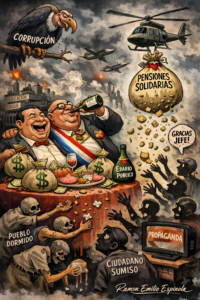
Se subsidia con ternura maternal a empresas poderosas —turísticas y mineras— que, pobres criaturas, no podrían sobrevivir sin el auxilio del erario. Del dinero del pueblo.
Se distribuye combustible gratuito a ministros, directores y sus séquitos, como si gobernar fuese una especie de deporte extremo que requiere constante hidratación fósil.
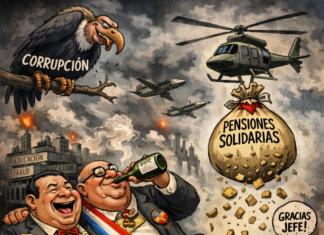
Y, como obra cumbre del ingenio nacional, aparecen las llamadas “pensiones solidarias”.
Solidarias, sí… pero entre cómplices.
Pensiones para ladrones y bandidos políticos, para vagos sociales como muchos que conocemos, revolucionarios de pacotillas y asaltantes de pueblos. Defensores de dictadores.
Porque no se trata de aliviar la miseria, sino de premiar la lealtad partidaria.
Individuos que jamás aportaron al Estado más que ruido, consignas y una disciplina casi zoológica para repetir disparates, son ahora pensionados con la solemnidad de quienes han servido a la patria… cuando en realidad la han ordeñado.
Algunos, incluso, dedican su vida a denostar al “imperio” mientras disfrutan, con admirable coherencia ideológica, de sus beneficios.
Condenan con furia lo que consumen con entusiasmo. Una forma superior de gimnasia moral. Qué malditos son.
Y mientras tanto, los verdaderos merecedores —maestros, obreros del azúcar, trabajadores invisibles— observan el reparto desde la grada de la resignación. No gritan. No protestan. Quizá porque aún creen, ingenuamente, que el mérito tiene algún valor en este teatro.
Pero no.
En esta obra, el mérito es un extra sin diálogo.
Lo verdaderamente inquietante no es la corrupción —esa es vieja conocida—, sino la anestesia social que la acompaña.
Un país sedado entre alcohol, banalidad y evasión, donde la indignación ha sido sustituida por el entretenimiento y la memoria por el olvido conveniente.
El pueblo no está dormido.
Está cuidadosamente adormecido.
CONCLUSIÓN
El parasitismo social no es una anomalía: es un sistema.
Un ecosistema perfectamente equilibrado donde unos pocos viven del esfuerzo de muchos… y muchos defienden, con sorprendente fervor, a quienes los empobrecen.
La corrupción no solo roba dinero: roba dignidad, roba futuro y —lo más grave— roba la capacidad de indignarse.
Y cuando un pueblo pierde esa capacidad, ya no necesita cadenas.
Se gobierna solo.
EPÍLOGO
Tal vez un día —cuando la tempestad deje de ser metáfora y se convierta en ruina palpable— alguien se pregunte cómo ocurrió todo.
Y la respuesta será incómodamente simple:
Ocurrió porque se toleró.
Porque se justificó.
Porque se aplaudió.
Porque mientras unos robaban, otros miraban… y algunos hasta agradecían.
Ese día, quizás, alguien recordará que el trabajo no era solo una forma de subsistir, sino también un acto de dignidad.
Y que el verdadero parasitismo no era solo el del corrupto… sino también el de la conciencia que decidió no incomodarse.
Y entonces —solo entonces— quedará una pregunta suspendida en el aire, más pesada que cualquier crisis:
¿En qué momento dejamos de ser ciudadanos… para convertirnos en cómplices silenciosos?
SOCIAL PARASITISM
“The horizon is dark, the storm threatens; let us work. This is the only remedy for the illness of the century.” — André Maurois
(To today’s youth, they may understand—if they still have the patience amid so much distraction—that the greatest dignity of human existence lies not in noise or slogans, but in silent study and honest work.)
The horizon is not gray—it is deliberately black. Not by divine design, but by human hands, which are far more efficient when it comes to ruining what works.
The crisis in the Middle East shakes hydrocarbons; these, in turn, rattle global markets, and the markets—as always—tremble with that refined hysteria of the wealthy when they sense they might become slightly less wealthy.
And, of course, the Dominican Republic could not miss the spectacle.
It would be historically impolite to forgo the opportunity to improvise.
The government, which until yesterday paraded itself as an Olympic tightrope walker capable of dancing over any crisis, has now abruptly descended to the ground of reality… only to ask the population for “restraint” and “sacrifice.” Such noble, useful words—especially when uttered by those who have no intention of practicing them.
Because one must ask—however uncomfortable it may be:
Where is the restraint in public spending?
Where is the moderation in governance?
Where is that famous “redefinition of priorities”?
Perhaps they are hidden—like common sense—in some forgotten drawer of the State.
Meanwhile, the spectacle continues:
Powerful companies—tourism and mining alike—are subsidized with maternal tenderness, as if these fragile entities could not survive without the nurturing embrace of public funds.
Free fuel is generously distributed to ministers, directors, and their entourages, as though governing were an extreme sport requiring constant fossil hydration.
And, as the crowning achievement of national ingenuity, we encounter the so-called
“Solidarity pensions.”
Solidarity, indeed,… but among accomplices.
For this is not about alleviating poverty, but about rewarding partisan loyalty.
Individuals who have never contributed to the State anything beyond noise, slogans, and an almost zoological discipline for repeating nonsense are now pensioned with the solemnity reserved for those who have served the nation… when in reality, they have merely milked it.
Some even dedicate their lives to denouncing the “Empire” while enthusiastically enjoying its benefits. They condemn with fervor what they consume with delight—a higher form of moral gymnastics.
Meanwhile, the truly deserving—teachers, sugar industry workers, invisible laborers—watch the distribution from the stands of resignation. They do not shout. They do not protest. Perhaps because they still believe, naively, that merit holds some value in this theater.
But it does not.
In this play, merit is merely an extra with no lines.
What is truly disturbing is not corruption—it is an old acquaintance—but the social anesthesia that accompanies it. A nation sedated by alcohol, triviality, and escapism, where indignation has been replaced by entertainment, and memory by convenient forgetfulness.
The people are not asleep.
They have been carefully lulled.
CONCLUSION
Social parasitism is not an anomaly—it is a system.
A perfectly balanced ecosystem where a few live off the labor of many… and many defend, with astonishing fervor, those who impoverish them.
Corruption does not only steal money—it steals dignity, it steals the future, and—most dangerously—it steals the capacity for outrage.
And when people lose that capacity, they no longer need chains.
They govern themselves.
EPILOGUE
Perhaps one day—when the storm ceases to be metaphor and becomes tangible ruin—someone will ask how it all happened.
And the answer will be uncomfortably simple:
It happened because it was tolerated.
Because it was justified.
Because it was applauded.
Because while some were stealing, others were watching… and some were even grateful.
That day, perhaps, someone will remember that work was not merely a means of survival, but an act of dignity.
And that true parasitism was not only that of the corrupt… but also that of the conscience that chose not to be disturbed.
And then—only then—one question will hang in the air, heavier than any crisis:
At what moment did we stop being citizens… and become silent accomplices?