


POR EL TRILLO DE LA INTRAHISTORIA
LA REALIDAD DEL DISTRITO 13
MENTIRA: LA DOMINICANIDAD NO ESTÁ EN JUEGO
Por Ramón Emilio Espinola
RESUMEN
La contienda política por el Distrito Congresional 13 de Nueva York ha sido presentada por algunos sectores como una batalla por la defensa de la dominicanidad. Sin embargo, detrás de esa narrativa emocional se esconden las realidades permanentes de la política contemporánea: la lucha por el poder, la influencia de los grupos económicos, la competencia por los recursos electorales y la necesidad de conservar espacios de representación. Este ensayo examina críticamente los discursos utilizados durante la campaña, analiza el contexto socioeconómico del distrito y cuestiona la utilización de la identidad nacional como instrumento propagandístico. Más que una disputa sobre cultura dominicana, la confrontación parece responder a los mecanismos tradicionales de la política partidista estadounidense.
INTRODUCCIÓN
Existe una vieja costumbre en la política moderna: cuando faltan argumentos, se recurre a las emociones; cuando escasean los resultados, se invoca la identidad; y cuando la realidad resulta incómoda, se fabrica una epopeya.
La lucha electoral que actualmente se desarrolla en el Distrito 13 de Nueva York parece encajar perfectamente dentro de esa tradición. Algunos pretenden presentar la contienda como una cruzada patriótica, como una especie de nueva Guerra Restauradora librada entre anuncios televisivos, redes sociales y fotografías cuidadosamente calculadas por expertos en mercadeo político.
Pero la realidad suele ser menos romántica.
Este es mi cuarto escrito sobre la encarnizada competencia que se desarrolla en dicho distrito. Debo aclarar que no vivo allí ni voto allí. Resido en el Upper West Side de Manhattan y, por tanto, el resultado de esa elección no alterará mi vida cotidiana. Sin embargo, hay algo que me resulta profundamente irritante: la insistencia de algunos actores políticos en afirmar que lo que está en juego es la dominicanidad.
No lo creo.
Y no lo creo porque la dominicanidad es mucho más que una bandera agitada en tiempos electorales, mucho más que un eslogan diseñado por asesores de campaña o una palabra repetida hasta el cansancio en actos partidistas.
La dominicanidad es historia, cultura, memoria colectiva, sacrificio nacional y conocimiento de nuestras raíces.
Resulta difícil aceptar que una elección primaria entre dos aspirantes pueda convertirse repentinamente en el último bastión de la identidad dominicana.
Si sometiéramos a muchos de nuestros dirigentes políticos a un examen serio sobre la historia nacional, sobre instituciones culturales como La Filantrópica, El Palladium, los movimientos intelectuales dominicanos o los procesos históricos que moldearon nuestra nación, probablemente descubriríamos que la dominicanidad que dicen defender existe más en los discursos que en sus conocimientos.
Porque la verdad es incómoda: la mayoría de las campañas políticas no son guerras culturales; son competencias por poder, influencia, prestigio y acceso a recursos.
La política funciona así desde los tiempos de Pericles, pasando por Maquiavelo, hasta nuestros días.
Los candidatos representan intereses legítimos, pero también coaliciones económicas, estructuras partidarias, grupos de presión y sectores que esperan beneficios futuros.
Quien financia campañas multimillonarias rara vez lo hace movido únicamente por sentimientos patrióticos.
La política no es una organización benéfica. Como decía el viejo refrán popular: cuando alguien le invita a cenar, siempre hay alguien pagando la cuenta.
Por eso la pregunta relevante no es quién pronuncia mejor la palabra dominicanidad.
La pregunta es otra:
¿Qué ha ocurrido realmente con la calidad de vida de los residentes del Distrito 13?
¿Qué avances concretos se observan en materia de vivienda, educación, movilidad social y oportunidades económicas?
¿Qué resultados verificables pueden exhibirse después de años de representación política?
¿Y qué beneficios para esa comunidad podría traer quien se ha declarado socialista en un congreso antisocialista? Dominado por capitalistas. Declararse socialista en una ciudad como Nueva York donde opera Wall Street es la mayor torpeza que se puede escuchar.
Esas son las preguntas que suelen desaparecer cuando los estrategas electorales descubren que las emociones producen más votos que las estadísticas.
Y así, mientras los problemas reales permanecen sentados en la sala de espera, la retórica patriótica desfila por la alfombra roja de la campaña electoral.
No es un fenómeno nuevo.
Es simplemente la vieja política usando disfraces nuevos.
Como conclusión para el ensayo completo, le sugeriría una línea de cierre como esta:
CONCLUSIÓN
La verdadera discusión del Distrito 13 no debería girar alrededor de quién agita con mayor entusiasmo la bandera dominicana, sino sobre quién puede contribuir a mejorar las condiciones materiales de vida de sus residentes.
La identidad cultural constituye un patrimonio invaluable, pero no paga alquileres, no mejora escuelas y no reduce la desigualdad por sí sola.
La política debe ser evaluada por resultados antes que por consignas.
EPÍLOGO
Las campañas terminan. Los anuncios desaparecen. Las pancartas son retiradas. Los estrategas cobran sus honorarios y los candidatos regresan a sus oficinas. Lo único que permanece son los ciudadanos enfrentando los mismos desafíos de siempre. Por eso la historia suele ser más severa que los votantes: mientras las elecciones premian la popularidad del momento, la historia juzga la utilidad real de una gestión. Y la historia, a diferencia de los consultores políticos, rara vez acepta excusas.
Porque al final a quién le importa si un candidato se llama “progresista” o “socialista” porque lo que preocupa es el pago de la renta y el gasto del supermercado
Bibliografía básica para aprender de política
- Alexis de Tocqueville. La democracia en América.
- Niccolò Machiavelli. El Príncipe.
- Robert A. Dahl. Who Governs? Democracy and Power in an American City.
- Samuel P. Huntington. Political Order in Changing Societies.
- Latino Data Project, New York (informes demográficos).
- CUNY Dominican Studies Institute (estudios sobre la población dominicana en Nueva York).
- NYC Housing and Vacancy Survey.
- David Harvey. Rebel Cities: From the Right to the City to the Urban Revolution.
- U.S. Census Bureau (datos socioeconómicos y demográficos).
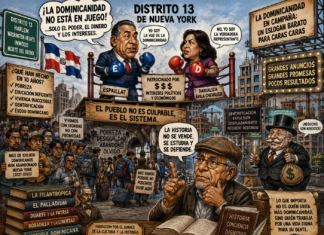
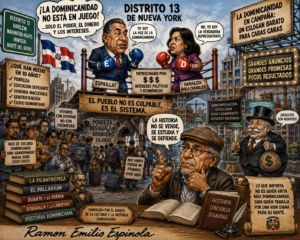
Caricatura elaborada por IA de acuerdo con mis especificaciones.
ENGLISH VERSION:
ON THE PATH OF INTRAHISTORY
THE REALITY OF DISTRICT 13
MYTH: DOMINICAN IDENTITY IS NOT AT STAKE
By Ramón Emilio Espinola
ABSTRACT
The political contest for New York’s 13th Congressional District has been portrayed by some sectors as a battle for the defense of Dominican identity. However, behind this emotional narrative lie the enduring realities of contemporary politics: the struggle for power, the influence of economic groups, competition for electoral resources, and the need to preserve spaces of representation. This essay critically examines the discourse used during the campaign, analyzes the socioeconomic context of the district, and questions the use of national identity as a propaganda tool. Rather than a dispute over Dominican culture, the confrontation appears to respond to the traditional mechanisms of American party politics.
INTRODUCTION
There is an old habit in modern politics: when arguments are lacking, emotions are invoked; when results are scarce, identity is appealed to; and when reality becomes uncomfortable, an epic narrative is fabricated.
The electoral struggle currently taking place in New York’s 13th District seems to fit perfectly within that tradition. Some attempt to present the contest as a patriotic crusade, as a kind of new Restoration War fought through television ads, social media, and photographs carefully staged by political marketing experts. But reality is usually less romantic.
This is my fourth essay on the fierce competition taking place in this district. I must clarify that I do not live there, nor do I vote there. I reside on Manhattan’s Upper West Side, and therefore, the outcome of this election will not affect my daily life. However, there is something that deeply irritates me: the insistence of some political actors in claiming that what is at stake is Dominican identity.
I do not believe it.
And I do not believe it because Dominican identity is much more than a flag waved in electoral times, much more than a slogan designed by campaign advisors, or a word repeated endlessly at party rallies.
Dominican identity is history, culture, collective memory, national sacrifice, and knowledge of our roots.
It is difficult to accept that a primary election between two candidates could suddenly become the last stronghold of Dominican identity.
If we were to subject many of our political leaders to a serious examination of national history—of cultural institutions such as La Filantrópica, El Palladium, Dominican intellectual movements, or the historical processes that shaped our nation—we would probably discover that the Dominican identity they claim to defend exists more in their speeches than in their knowledge.
Because the truth is uncomfortable: most political campaigns are not cultural wars; they are competitions for power, influence, prestige, and access to resources.
Politics has functioned this way since the time of Pericles, through Machiavelli, and up to the present day.
Candidates represent legitimate interests, but also economic coalitions, party structures, pressure groups, and sectors expecting future benefits.
Those who finance multimillion-dollar campaigns rarely drive solely by patriotic sentiment.
Politics is not a charitable organization. As the old popular saying goes, when someone invites you to dinner, there is always someone paying the bill.
That is why the relevant question is not who pronounces the word “Dominican identity” better.
The question is another:
What has really happened to the quality of life of the residents of District 13
What concrete progress can be observed in housing, education, social mobility, and economic opportunity?
What verifiable results can be shown after years of political representation?
And what benefits for that community could come from someone who has declared himself a socialist in an anti-socialist congress dominated by capitalists? Declaring oneself a socialist in a city like New York, where Wall Street operates, is the greatest political miscalculation one can hear.
These are the questions that tend to disappear when electoral strategists discover that emotions produce more votes than statistics.
And so, while real problems remain sitting in the waiting room, patriotic rhetoric parades down the red carpet of electoral campaigns.
This is not a new phenomenon.
It is simply old politics wearing new disguises.
CONCLUSION
The real discussion of District 13 should not revolve around who waves the Dominican flag with greater enthusiasm, but rather who can contribute to improving the material living conditions of its residents.
Cultural identity is an invaluable heritage, but it does not pay rent, does not improve schools, and does not reduce inequality on its own.
Politics must be evaluated by results rather than slogans.
EPILOGUE
Campaigns end. Advertisements disappear. Posters are taken down. Strategists collect their fees and candidates return to their offices. What remains are the citizens facing the same old challenges.
That is why history tends to be more severe than voters: while elections reward momentary popularity, history judges the real usefulness of governance. And history, unlike political consultants, rarely accepts excuses.
Because in the end, what does it matter if a candidate calls himself “progressive” or “socialist” when what truly matters is paying the rent and buying groceries.
BASIC BIBLIOGRAPHY FOR LEARNING ABOUT POLITICS
• Alexis de Tocqueville. Democracy in America.
• Niccolò Machiavelli. The Prince.
• Robert A. Dahl. Who Governs? Democracy and Power in an American City.
• Samuel P. Huntington. Political Order in Changing Societies.
• Latino Data Project, New York (demographic reports).
• CUNY Dominican Studies Institute (studies on the Dominican population in New York).
• NYC Housing and Vacancy Survey.
• David Harvey. Rebel Cities: From the Right to the City to the Urban Revolution.
• U.S. Census Bureau (socioeconomic and demographic data).
AI-generated caricature according to my specifications.

